
Most people assume tint is tint. Then two quotes turn up for what looks like the same dark window, and the prices are nowhere near each other.
Here’s the short answer. Regular tint is dyed film that works mostly by being dark. Ceramic window tint uses tiny, non-metallic ceramic particles that block infrared heat directly, so it keeps the cabin considerably cooler, holds its colour longer, and doesn’t need to be dark to do the job. Whether that’s worth paying extra depends on how you use your car, and we’ll be straight about that below.
What Regular (Dyed) Window Tint Actually Does
Dyed film is the standard, budget-friendly option. It has a layer of dye in the film, and it works by absorbing light. That cuts glare, adds privacy and takes the edge off a bright day.
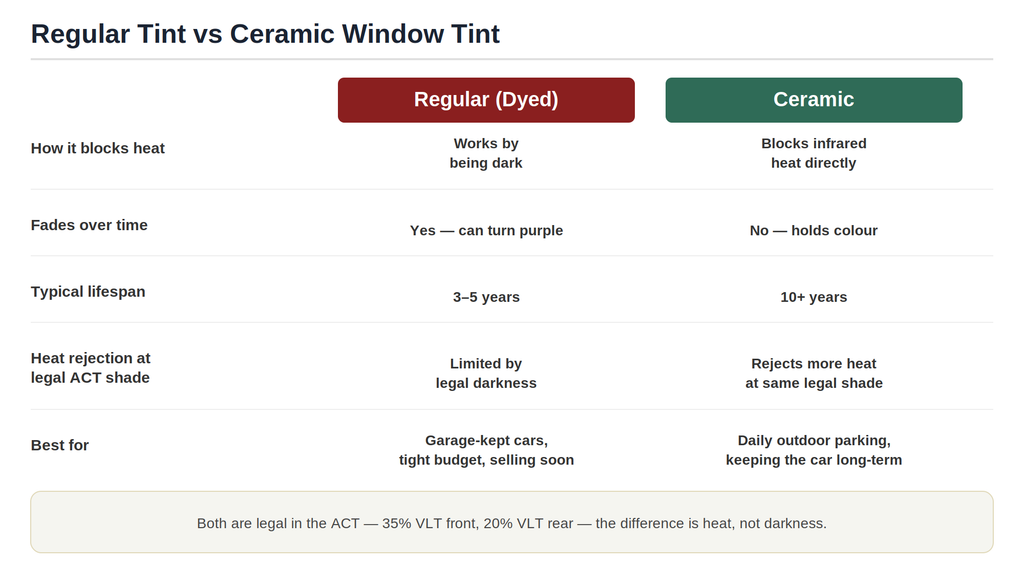
For plenty of cars, that’s perfectly fine. The weak point is the dye itself. Sunlight slowly breaks it down, which is how old, cheap tint ends up faded or that unmistakable shade of purple. It’s also the least effective option for heat, because it mostly works by being dark. In the ACT you can only go so dark on the front windows, so there’s a ceiling on how much heat a dyed film can deal with.
What Makes Ceramic Window Tint Different
Ceramic film swaps the dye for nano-ceramic particles. They don’t fade under UV the way dye does, and they’re built to block infrared, the part of sunlight you actually feel as heat. The result is a clear, neutral-looking film that can reject a lot of heat without turning your windows into a cave.
Because the particles are non-metallic, ceramic also doesn’t interfere with your phone signal, GPS or radio. That old complaint about tint messing with reception was mostly about metalised films.
One quick clarification, since we do both. Ceramic window tint is a different product from ceramic coating, which is a protective layer for your paint. Same word, completely different job.
Heat Rejection: The Difference You’ll Actually Feel
You know the moment. It’s January, you’ve left the car in an open car park in Canberra for a few hours, and you open the door to a wall of heat, a steering wheel you can’t hold and seat belt buckles that could brand a cow.
Good film of either type blocks most UV, so that isn’t where the two really differ. The gap is heat. Ceramic goes after infrared directly, which is why the cabin tends to be noticeably cooler and the air con doesn’t have to fight as hard when you first get in.
The ACT rules make this matter even more. Front side windows can’t go darker than 35% VLT, so darkness can only take you so far. A quality ceramic film at a legal shade will often reject more heat than a darker dyed film, because it’s working on infrared instead of just dimming the light. You get the cooler car without pushing the limit.
Does Ceramic Tint Fade Like Dyed Tint Does?
The purple fade is real, but it’s a dyed-film problem, not a tint problem. The dye breaks down under UV, and after enough Canberra summers the film goes purple or patchy and stops doing its job. Ceramic has no dye to break down, so that failure doesn’t happen the same way.
As a rough guide from industry sources, dyed film often starts looking tired somewhere around three to five years, sooner in harsh sun. Quality ceramic commonly lasts ten years or more. Those are ballparks, not promises. Installation matters just as much as the film. A great film put on badly will still bubble and lift at the edges. We’ve seen what a cheap tint job looks like after a year of Canberra sun, and it’s not pretty.
Is the Extra Cost Worth It?
It depends, and anyone who tells you it’s always worth it is selling something.
Ceramic tends to earn its money if:
- Your car sits outside in the sun most days, at home or at work
- You plan to keep the car for years, not months
- You’ve got kids or passengers in the back, or you do long drives
- You want the coolest cabin possible while staying legal
Dyed film can make sense if the car lives in a garage, you’re selling soon, or the budget is tight and you mainly want privacy and a sharper look. Just be aware that a cheap tint that fades in a few years means paying to have it removed and redone.
We haven’t put a price on this page because it depends on your car and the film you choose. That’s what the free assessment is for.
Frequently Asked Questions
Does ceramic tint block more heat than regular tint?
Yes, in most cases considerably more. Dyed film mostly cuts heat by being dark, while ceramic blocks infrared directly. That’s why a lighter, legal ceramic film can outperform a darker dyed one.
Will ceramic tint interfere with GPS or phone signal?
No. Ceramic film is non-metallic, so it doesn’t block signals. The reception problems people remember came from metalised films. If you’ve heard the rumour, that’s where it started.
How long does window tint actually last?
It varies with the film, the installation and how much sun the car gets. As a general guide, dyed film often lasts around three to five years, while quality ceramic can last ten years or more. Ask any tinter what warranty comes with the specific film they’d use on your car.
Is ceramic tint legal in the ACT?
Yes, as long as the shade is legal. The rules are about how much light gets through, not what the film is made of. Front side windows need to let through at least 35% of light. Rear side windows and the rear windscreen can go down to 20%. Only a strip at the top of the windscreen can be tinted, and mirror-like reflective film isn’t allowed. The number that counts is the finished window, glass and film together. If you drive a ute or van, the rules for windows behind the driver are different, so ask us. Every install we do is ACT compliant, and u003ca href=u0022https://www.accesscanberra.act.gov.au/driving-transport-and-parking/registration/vehicle-windscreen-and-window-tintingu0022u003eAccess Canberrau003c/au003e publishes the official rules if you’d like to read them yourself.
What Canberra Drivers Say About Their Tint Jobs
We’d rather you hear it from customers. A few lines from our Google reviews:
“It has significantly reduced the heat and glare inside” (James Fan, on his ceramic tint)
“The tint came out flawless and the workmanship is excellent.” (sukhvir singh)
“Nothing felt rushed” (Preet Singh)
“Honest advice tailored to what I actually needed” (Loretta Toms)
“Recommends what suits the customer rather than trying to upsell unnecessary extras” (Susmitha Gupta)
Not Sure Which Film Suits Your Car?
Come in for a free assessment. We’ll look at the car, talk through how you use it, and give you an honest answer on whether ceramic is worth it for you or whether a simpler film will do. See the full range on our Car Window Tinting page, or get in touch and we’ll take it from there.
The Short Version
- Regular tint is dyed film that works by being dark. Ceramic tint blocks infrared heat without needing to be dark.
- Ceramic is non-metallic, so it won’t affect your GPS, phone signal or radio.
- Dyed film can fade purple over time. Quality ceramic is built to hold its colour for a decade or more.
- Ceramic is legal in the ACT as long as the shade is: at least 35% VLT on the front sides and 20% on the rear.
- Whether it’s worth it depends on how much sun your car sees and how long you’ll keep it.