
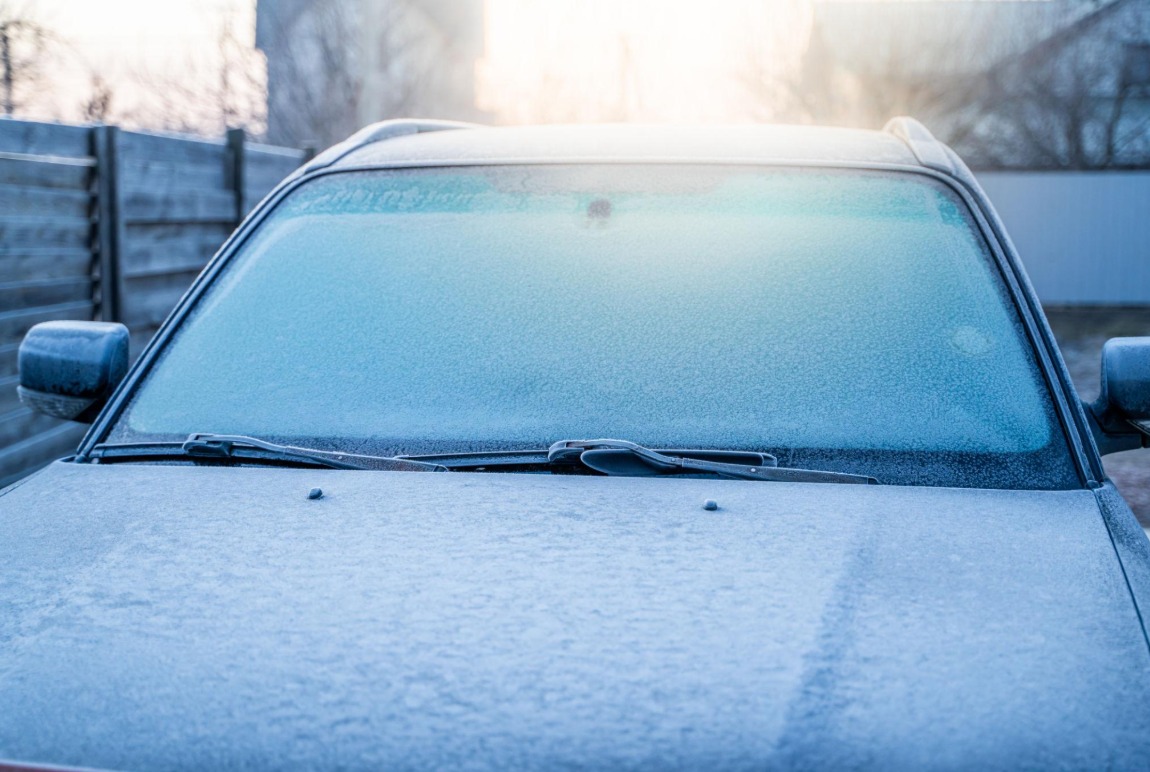
Frost damages your paint by repeatedly freezing and expanding whatever’s sitting on top of it, water, road grime, sap, bird droppings, then trapping it there long enough for the moisture to seep into micro-scratches and swirl marks. On its own, one frosty morning won’t hurt anything. But Canberra gets dozens of frost mornings every winter, Canberra is widely reported as Australia’s coldest capital (ABC News), and it’s that repetition that wears clear coat down over a winter. Add in scraping, rushed de-icing and road salt, and by September a lot of cars roll into our shop looking noticeably duller than they did in May. Here’s what’s actually going on and how to stop it before it costs you a respray.
What’s Actually
Happening to Your
Paint at 2°C
Clear coat isn’t glass smooth, even on a well-maintained car there are thousands of microscopic scratches from washing, wind-blown grit and general road use. In warm weather that’s mostly cosmetic. In winter it’s an entry point.
When your car sits out overnight in Canberra, and July mornings regularly dip close to freezing or below, any moisture on the surface works its way into those tiny scratches before it freezes. Water expands by about 9% as it turns to ice. Multiply that by every micro-scratch on your bonnet and roof, night after night, and you get a slow prying-open effect. It’s the same mechanism that cracks footpaths and burst pipes, just happening on a much smaller scale on your paint.
This is also why cars that already have some swirl marks or old touch-up work tend to age faster in a Canberra winter than freshly detailed ones. The damage isn’t random, it’s finding the weak points that already exist.
The De-Icing Mistake Everyone Makes
We see this one constantly, someone’s running late, the windscreen’s frosted over, and out comes a kettle of hot water or a scraper dragged across the glass like a squeegee.
Both are bad news:
Hot water on a frozen windscreen creates a sudden temperature shock. Glass expands unevenly and it genuinely can crack, we’ve had customers come in with a windscreen that split from corner to corner because of this exact move. It’s not an old wives’ tale, it happens.
Metal or hard plastic scrapers used on paint (not just glass) will cut straight through a thin layer of ice and into the clear coat underneath if there’s any grit trapped in that ice.
Road dust settles on your car overnight, freezes into the ice layer, and suddenly your “gentle” scrape is dragging sandpaper across the bonnet.
What actually works is lukewarm water (never boiling), a proper rubber-edged scraper for glass only, or just running the demister and giving it five extra minutes. Not glamorous, but it’s the difference between a clear windscreen and a $600 replacement.
Salt, Grit & Road Treatment Chemicals — the Silent Paint Killer
Canberra doesn’t salt roads the way Melbourne or Sydney’s mountain routes do, but the ACT and surrounding NSW towns do use grit and de-icing treatments on black ice hotspots, bridges, and steeper suburban streets, especially around Tuggeranong and the hills where cold air pools overnight.
That grit and chemical residue gets thrown up by your tyres and sits in your wheel arches, along your lower panels and in your undercarriage. Left there, it holds moisture against the metal and accelerates corrosion in exactly the spots that are hardest to see, wheel arch lips, sill panels, exhaust brackets. By the time surface rust is visible, it’s usually already established underneath.
This is the damage nobody notices because it’s not on the bonnet where you’re looking. It’s underneath, and it’s cumulative.
Garage vs Carport vs Driveway — What Canberra Conditions Actually Need
Not every car owner has a garage, so here’s the honest breakdown of what each setup means for your paint this winter.
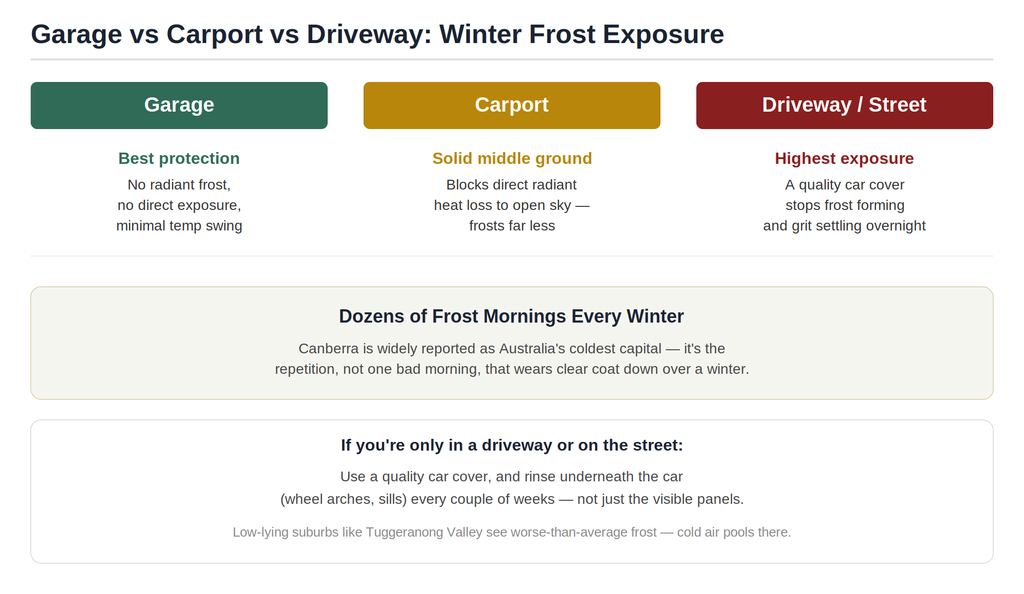
Garage: Best protection, full stop. No radiant frost, no direct exposure, minimal temperature swing overnight. If you’ve got one, use it, especially on clear, still nights, which are exactly when radiation frost is worst.
Carport: Solid middle ground. It blocks the direct radiant heat loss to the open sky (the main cause of frost) even without solid walls. Cars under a carport typically frost far less than those fully exposed, even a few metres away.
Driveway/street parking: Highest exposure. If this is your only option, a quality car cover makes a real difference, it won’t stop cold, but it stops frost forming directly on the paint and stops grit settling in overnight. Combine that with a wash routine that gets underneath the car every couple of weeks, not just the visible panels.
If you’re in a low-lying or open suburb, think Tuggeranong Valley or anywhere near a creek line, budget for worse frost than the Canberra average. Cold air pools in those spots.
Frequently Asked Questions
Can I wash my car in winter?
Yes, and you should, that’s when it matters most. Wash off grit and residue every 1 to 2 weeks. Just avoid washing right before a hard frost is forecast, ideally do it earlier in the day so the car has time to dry before temperatures drop overnight.
Does cold weather affect ceramic coating?
Not the coating itself once it’s cured, a properly applied ceramic coating handles Canberra winters without issue. The concern is more about application, we won’t apply new ceramic coating in very low temperatures because it needs a stable environment to cure properly. If you’re getting one done, we plan around the cold snaps.
Is it safe to use PPF in frost?
The film itself is fine sitting in frost once it’s installed and cured. Where it gets tricky is fresh installation, PPF needs a certain temperature range to bond properly, so we simply schedule installs for milder days or do them indoors in a controlled bay.
The Bottom Line
- Canberra’s 60 to 80 frost days a year cause damage through repetition, not one bad morning
- Never use hot water on a frosted windscreen and keep scrapers off paint entirely
- Wheel arches and undercarriage collect grit and moisture that you can’t see, rinse them regularly
- Garages beat carports beat open exposure, but a cover and a good wash routine can close most of the gap
- Ceramic coating and PPF both hold up fine in the cold, it’s the application that needs the right conditions
Not sure how your paint’s holding up this winter? Bring it in for a free winter paint assessment, we’ll check for early swirl damage, wheel arch corrosion and coating condition before it turns into a bigger job.