
If you’ve been looking into paint protection lately, you’ve probably noticed that the word “ceramic” gets thrown around everywhere. It’s become a catch-all term for anything that makes a car shiny and easy to wash.
And just when you thought you had a handle on ceramic coatings, ads for graphene coatings started popping up all over your feed promising “wonder-material” protection.
It’s confusing, and honestly, most car owners genuinely don’t know what they’re being sold or if the extra cost is actually worth it. Let’s strip away the marketing hype and look at what these two options actually do in the real world—so you can make an informed choice for your vehicle.
What Ceramic Coating Actually Does
At its core, a professional ceramic coating is a liquid polymer (usually based on Silicon Dioxide, or SiO2) that bonds with your car’s factory paint.
When applied correctly, it fills in microscopic imperfections in the clear coat and cures into a hard, glossy, chemical-resistant layer. Think of it as a ultra-durable replacement for traditional wax.
What ceramic coating does really well:
- Makes washing effortless: It creates a sleek, slick surface so dirt, traffic film, and bug splatter slide off easily without harsh scrubbing.
- Adds deep, glass-like gloss: It drastically enhances depth and reflectivity, keeping paint looking like it just left the showroom.
- Protects against minor chemistry: It guards your clear coat against chemical etching from bird droppings, tree sap, and road salt.
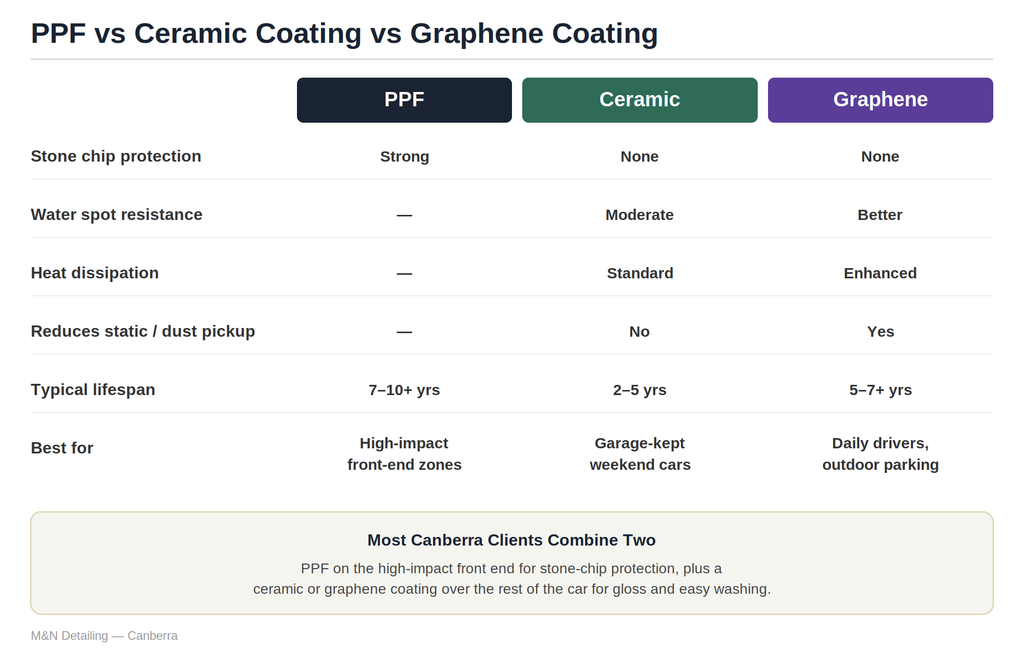
What it doesn’t do: It won’t protect your car from flying stone chips or deep scratches (that’s what Paint Protection Film/PPF is for), and it isn’t completely immune to mineral water spots if water bakes on a hot panel.
What Graphene Coating Actually Does (And How It’s Different)
Graphene is often called a “wonder material” because it’s a single layer of carbon atoms arranged in a honeycomb lattice, making it incredibly strong, lightweight, and conductive.
In automotive care, graphene isn’t used as a pure sheet. Instead, reduced graphene oxide is infused into an existing ceramic (SiO2) framework.
Now, let’s take a look at the difference it makes from conventional ceramic.
- Less Water Spots: Since graphene disperses heat fast and decreases the temperature of the painted surface, water evaporates with less thermal bond, thus decreasing the amount of annoying mineral water spots, which the ceramic coatings tend to develop.
- Slightly Increased Tensile Strength & Slipperiness: The presence of graphene makes the coating more slippery, which will help withstand minor scratches when washing.
- Absence of Static Charge: Since graphene conducts electric charge, the static charge on the panels of your vehicle is reduced, thus attracting less dust when it is parked.
Durability — Which One Lasts Longer?
On paper, graphene coatings are often rated for longer lifespans (often advertised at 5 to 7+ years) compared to entry-level ceramic coatings (roughly 1 to 5 years, depending on the product).
However, real-world durability depends far more on application quality and maintenance than the bottle itself.
A high-grade ceramic coating applied by a meticulous professional will outlast a poorly applied graphene coating every single time. Assuming both are prepped and applied flawlessly, a graphene-infused coating generally holds up slightly better against harsh weather, chemical washes, and environmental exposure over a longer timeline.
What About Paint Protection Film (PPF)?
Neither ceramic nor graphene coatings are designed to stop physical impacts like stone chips — that’s a job for paint protection film (PPF), a much thicker physical barrier applied directly over your paint. Many of our Canberra clients combine PPF on the high-impact front end with a ceramic or graphene coating over the rest of the car, getting stone-chip protection where it matters most and gloss everywhere else. See our complete PPF guide for the full breakdown of cost, installation and lifespan.
Hydrophobic Performance & Heat Resistance — The Real-World Difference
Both coatings offer incredible hydrophobic (water-beading) performance but they behave a little differently on the road:
- Water Beading vs. Water Sheeting: Ceramic coatings tend to create tight, round water beads that sit on the panel. On a hot summer day, if those beads dry out in the sun, they leave behind hard water spots. Graphene coatings promote slightly better water sheeting, allowing water to slide off the car completely before drying.
- Heat Resistance: The material graphene is an excellent conductor of heat and can dissipate it effectively. Therefore, in regions that are both hot and sunny, this quality helps the coating to retain its chemical composition for a longer time.
Which One Is Right for Your Car?
Not all options may be equally appropriate for everyone and everything – you have to take into account the purpose of your vehicle, its location, and the expectations.
- Daily driver: In case your car is stored outside, driven on a daily basis, and subjected to various weather conditions, a better choice would be a graphene coat, which provides better protection from water stains and dust accumulation.
- The Weekend Cruiser or Garage Queen: If your vehicle is driven occasionally and kept under cover, a quality ceramic coating will give you all the gloss, depth, and ease of washing you could ever want without spending extra for heat resistance you won’t need.
- New Cars Straight from the Dealer: Bringing a brand-new car in right away is the absolute best time for paint protection. Applying either ceramic or graphene while the clear coat is still fresh ensures maximum surface prep efficiency and locks in that flawless factory look before day-to-day wear sets in.
Frequently Asked Questions
Is graphene coating better than ceramic coating?
It’s not necessarily “better,” but it is an evolution. Graphene adds specific benefits—like reduced water spotting, better heat dissipation, and extra slickness. If those benefits align with how your car is used, it’s worth considering. Otherwise, a premium ceramic coating remains an outstanding option.
Can you apply graphene coating over PPF?
Yes, most definitely. When you apply a graphene or ceramic coating over PPF, you create a slippery, hydrophobic coating on top of the film that will make cleaning it much easier and protect the film from dirt accumulating within its pores.
What is the cost of ceramic coating in Canberra?
The price of ceramic coatings depends on many factors, such as the vehicle size and condition of the paintwork, including how much prep work needs to be done prior to applying the ceramic coating. See our Canberra Ceramic Coating Pricing Guide for more details.
Do I need to reapply ceramic coating every year?
No. True professional-grade ceramic coatings do not need to be completely reapplied annually. However, they do require basic maintenance—such as periodic decontamination washes and a ceramic boost spray every 6 to 12 months—to keep the hydrophobic top layer performing at its peak.
Which is better: graphene coating or PPF?
They protect against different things, so neither is better on its own. PPF is a thick physical film that stops stone chips and scratches. Graphene is a liquid coating that adds gloss, water repellency and easier washing, but it will not stop chips. If stone chips are your main worry, choose PPF. If gloss and easy washing matter most, choose a coating. Many owners combine PPF on the front end with a coating over the rest of the car.
Get Honest Advice, Not an Upsell
There is no reason to be subjected to any kind of high-pressure sales job when picking paint protection for your car. There are many differences between each individual car, and everyone’s needs vary.
Whether you’re leaning toward ceramic, curious about graphene, or just want an honest opinion on your paint’s current condition, we’re here to help.
Book a Free Paint Assessment at MN Detailing — Bring your car by, and we’ll give you a clear, honest recommendation with zero pressure to buy up-market packages you don’t need.