
Short answer: yes, EVs need paint protection, and in some ways they need it more than the petrol car you traded in. The clear coats on a lot of new EVs are thinner than what you’re used to, the extra weight from the battery changes how stone chips hit the panels, and the paint often cures differently depending on where the car was built. If you’ve just picked up a BYD, Tesla or Zeekr in Canberra, this is the stuff nobody tells you at the dealership.
We’ve been doing detailing and coating work on Canberra roads for years, and the last two years have been a different game entirely. Here’s what we’re actually seeing.
Why Australia Fell for EVs Overnight
Canberra has quietly become one of the strongest EV markets in the country. Cheaper models from BYD and Zeekr hit the market, charging infrastructure caught up, and suddenly EVs weren’t just a Tesla thing anymore. We’ve watched our appointment book shift over the last 18 months. It used to be mostly UTEs and family SUVs. Now we’re booking in just as many EVs, and a lot of them are brand new arrivals still on temporary plates.
The catch is that most new EV owners are coming from petrol cars and assume the paint care rules are the same. They’re not.
The Paint Problem Nobody Mentions at the Dealership
Here’s the part that surprises people. A lot of EVs, especially the Chinese-made models flooding into the market right now, run thinner clear coats than what we’re used to seeing on established petrol brands. Thinner clear coat means less margin for error. Less protection against UV, less protection against the fine grit that Canberra’s dry climate kicks up, and less room for correction if something goes wrong.
On top of that, panels can come off slightly different production lines with different curing processes, even on the same car. We’ve seen this firsthand when polishing panels back to back and noticing a difference in how they respond. It’s not something you’d catch by eye in the showroom, but it shows up the moment you start working on the paint.
Nobody at the dealership is going to walk you through this. It’s not their job. It’s ours.
Myth vs Fact: Ceramic Coating on Electric Cars
Myth: “It’s new, I don’t need coating yet.”
Fact: New paint is actually the best time to coat a car, not the worst. And EVs specifically carry extra risk factors that petrol cars don’t deal with in the same way.
The battery pack adds a serious amount of weight low in the chassis. That changes the suspension load, which changes how the car sits and how it absorbs impacts from road debris. We’re also seeing different tyre wear patterns on EVs because of the instant torque, which kicks up more grit and grime onto the lower panels and rear quarters. Combine that with stone chip exposure from a heavier car riding differently over Canberra’s backroads, and you’ve got paint doing more work than it did on your last car, with a thinner clear coat to do it.
Coating early isn’t an upsell. It’s just matching the protection to what the car is actually going to face.
What We’re Actually Seeing in Canberra
We’ve had a real run of BYD, Zeekr and DENZA vehicles through the shop this year, and the pattern is consistent. Owners bring the car in within the first few weeks, excited and proud, and we’re already finding swirl marks from the dealership prep wash, light stone chipping on the front bumper from the drive home, and in a couple of cases visible orange peel that’s more pronounced than what we’d expect on a comparable petrol model.
One Zeekr came in with barely 400km on the odometer and already had noticeable etching on the bonnet from being parked under a tree during delivery. A BYD owner brought their car in convinced something was wrong with the paint, when really it was just under-protected stock paint reacting to Canberra’s sun the way any unprotected paint would.
None of this is a knock on the brands. It’s just what happens when new technology meets old weather.
The 30-Day Checklist for New EV Owners
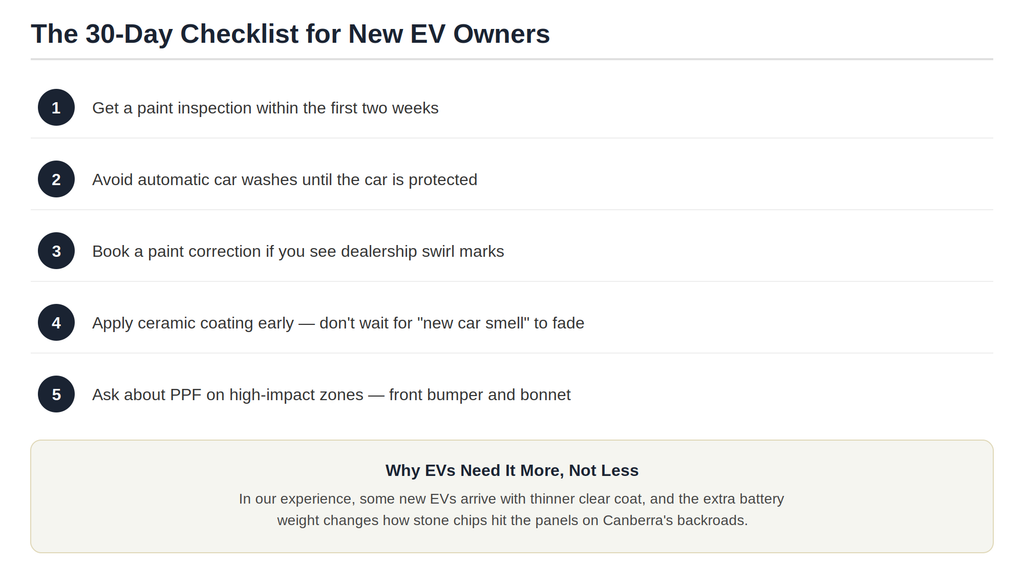
- Get a paint inspection before you do anything else, ideally within the first two weeks
- Avoid automatic car washes until the car has been properly protected
- Book a paint correction if you’re seeing dealership swirl marks (most cars have them)
- Apply ceramic coating early rather than waiting for the “new car smell” to wear off
- Ask about PPF on high-impact zones like the front bumper and bonnet, especially if you’re driving out toward Queanbeyan, Yass or the Cotter Road
Frequently Asked Questions
Does ceramic coating affect an EV’s charging port or sensors?
No. Coating is applied to the paintwork, not to charging components or sensor housings. We work carefully around ports, cameras and sensor clusters and there’s no functional interference with any of it.
Is PPF worth it on a car this new?
Yes, and arguably more so on a new EV than on a used petrol car. You’re protecting paint that’s thinner to begin with, on a car that’s heavier and exposed to more road debris. PPF on the front end catches the damage before it ever reaches the clear coat.
Do EVs scratch more easily than petrol cars?
Not inherently, but the thinner clear coats on several popular EV models mean less buffer before a scratch reaches deeper layers. It’s less about the car scratching easier and more about there being less protective material standing between a scratch and a real paint job.
If you’ve just picked up a new EV in Canberra, get it in front of us before the first proper wash. We’ll take a look at the paint, tell you exactly what condition it’s actually in, and put together a protection plan that matches how you’re going to drive it. Book your EV paint inspection with M&N Detailing today and give your new car the start it deserves.