Step into direct sunlight, glance down your car’s bonnet, and there they are—dozens of web-like light rings swirling right back at you. Most owners never spot swirl marks until light hits the panel at just the right angle. Once you see them, though, you can’t unsee them.
The good news? Those unsightly rings aren’t permanent paint damage, and they definitely don’t warrant a costly trip to a panel beater. Professional paint correction levels out these surface flaws, bringing back that deep, mirror-like factory gloss.
What Is Paint Correction?
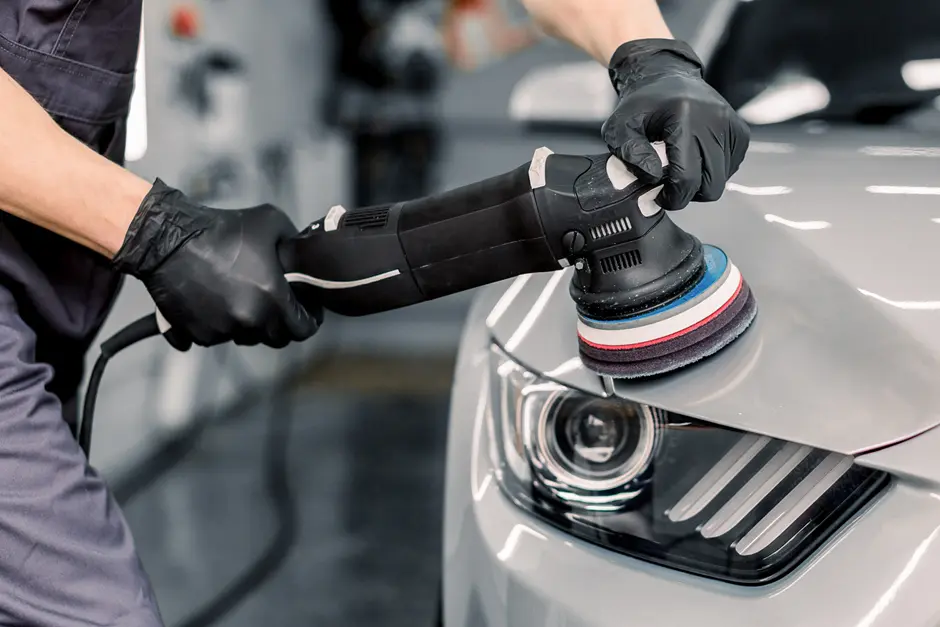
Paint correction is a machine-polishing process that removes a very thin layer of damaged clear coat to level out swirl marks, light scratches, water spots and oxidation. It restores gloss and clarity to the paint you already have, rather than hiding the flaws under filler the way a bottle of polish does.
How it works: a detailer uses a machine polisher with abrasive compounds and pads to cut away the damaged layer, then a finer polish to refine the finish. Light, medium or heavy correction (one, two or three stages) depends on how damaged the paint is.
What Paint Correction Actually Removes
At its core, paint correction is a careful mechanical polishing process. By shaving down a microscopic fraction of damaged clear coat, a detailer flattens out the imperfections trapped near the surface. Here is what that can and cannot fix:
| Surface Defect | Common Cause | Can Paint Correction Fix It? |
| Swirl Marks | Automatic car washes, dirty sponges, dry wiping down dust. | Yes — Easily cleared with light-to-medium polishing. |
| Oxidation | Extended UV rays breaking down clear coat into a hazy film. | Yes — Brings back original depth and color clarity. |
| Water Spots | Dried hard water etched into the clear coat by heat. | Yes — Strips away embedded mineral rings. |
| Light Scratches | Bushes, car keys grazing panels, fingernail marks around handles. | Mostly — Fully removable if the mark sits within clear coat depth. |
Cut and Polish vs a Bottle of Car Polish — Why They’re Not the Same Thing
If you’ve ever picked up a bottle of polish from an auto shop and rubbed down your bonnet by hand, you might wonder why professional machine buffing carries a higher price tag.
Off-the-shelf polishes are mostly fillers, silicones, and waxes. They sit over your paint, temporarily filling in micro-flaws so your car looks shiny for a couple of weeks—until rain washes them right back out.
A professional cut and polish actually repairs the surface:
- The Cut (Compounding): Uses heavy abrasive compounds and rotary or dual-action pads to slice off damaged clear coat at a microscopic level.
- The Polish (Refining): Uses fine finishing pads and light polish to smooth out micro-abrasions left behind by the cutting step, leaving a crisp, clear shine.
Where bottle polish masks defects for a short while, true correction removes the damage permanently.
The Process — Light, Medium, and Heavy Correction Explained
Not every vehicle needs three rounds of aggressive machine polishing. The right plan depends entirely on clear coat hardness, depth, and overall surface condition.
1-Stage (Light Correction)
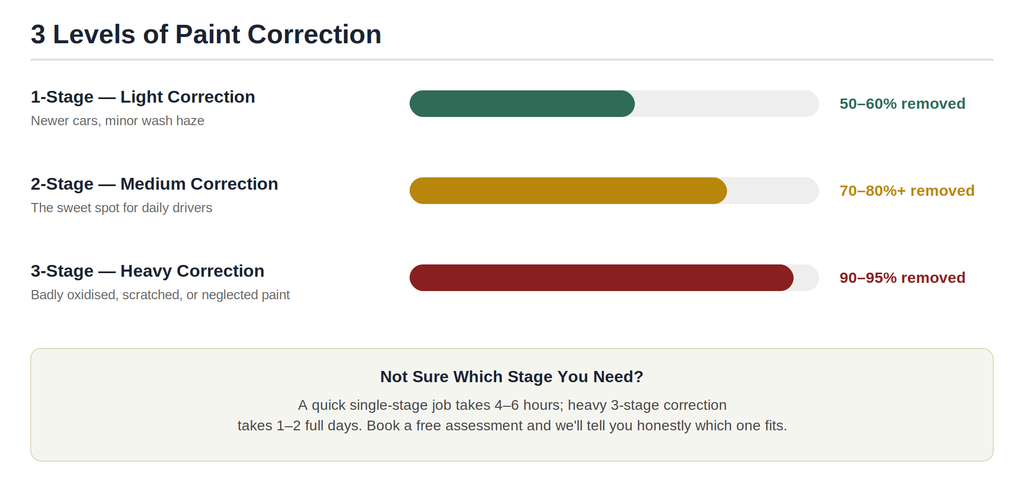
Great for newer cars or paintwork showing minor wash haze. Detailers run a single compound and pad setup, clearing out roughly 50%–60% of surface marks while boosting gloss significantly.
2-Stage (Medium Correction)
The sweet spot for daily drivers. It starts with an abrasive cutting compound to knock down stubborn swirls and minor scratches, followed by a refining polish to clear away compound haze. Expect 70%–80%+ defect removal.
3-Stage (Heavy Correction)
Saved for heavily oxidized, badly scratched, or neglected paint. It takes heavy compounding, medium refining, and ultra-fine finishing steps—sometimes paired with spot wet sanding. Restores up to 90%–95% of paint clarity.
Why Paint Correction Comes Before Ceramic Coating, Not After
Think of ceramic coating like liquid glass. As it cures, it seals tight over your car’s paintwork, forming a hard protective shell.
If you skip correction and slap a coating straight onto swirled paint, you permanently trap every scratch and water mark underneath. Under direct sun, those flaws stand out even more. Detailers always polish and refine paint before applying protective coatings so the finish stays flawless under the shield.
“Brought my car in with terrible swirl marks from the previous owner. The team completely transformed the paint—it looks smoother than the day I picked it up from the dealership.”
— Matthew Thomson, Verified Customer Review
FAQs
Will paint correction remove deep scratches?
If a scratch cuts deeper than your clear coat down into primer or metal (where a fingernail catches hard in the groove), machine polishing won’t erase it completely. Polishing rounds off the sharp edges so it catches less light, but true gouges require touch-up paint or panel repair.
How long does paint correction take?
A quick single-stage gloss enhancement generally takes 4 to 6 hours. Multi-stage heavy corrections take 1 to 2 full days of dedicated machine work and panel prep
Does it strip off the clear coat?
It removes a tiny fraction of a micron—usually around 2% to 5% of total clear coat thickness. Done by experienced professionals using digital paint depth gauges, it is completely safe for your factory finish.
Should I get this done before selling my car?
Definitely. Removing swirls and restoring high gloss drastically boosts presentation in listing photos and in-person viewings, frequently adding more to your final sale price than the service costs.
How much does paint correction cost in Canberra?
Pricing depends on how much correction your paint needs — a single-stage gloss enhancement costs less than a full 3-stage heavy correction on badly oxidized paint. Book a free assessment and we’ll give you an exact quote based on your car’s condition.
Free Paint Assessment
At M&N Detailing, we keep things straightforward. Drive your vehicle down to our shop for a free inspection under specialized detailing lights. We’ll tell you honestly whether your car needs light correction, heavy correction, or nothing at all.