
Walk into any auto shop in Fyshwick or drive past a local wash bay, and you will see the words ceramic coating slapped on practically everything. A fifty dollar bottle of spray-on liquid at Supercheap Auto promises the moon and stars. A drive-through car wash charges an extra tenner to spray a thin film over your windshield and calls it a ceramic treatment. Then a detailing studio hands you a quote for sixteen hundred bucks and tells you it is going to take two full days.
What gives? The industry is full of pure marketing spin, and almost nobody takes the time to explain what actually separates a cheap spray from a genuine professional application. You are left wondering if you are paying for real paint protection or just paying for someone else’s marketing budget. Let us pull back the curtain on how ceramic coatings actually work, what they can and cannot do for your paint, and whether your car actually needs one.
What Ceramic Coating Actually Is
First off, throw away the idea that a ceramic coating is just a super strong wax. Wax sits on top of your clear coat like cold butter on toast. It looks nice for a few weeks, but heat, rain, and a couple of aggressive car washes sweep it right down the drain.
A genuine ceramic coating is a liquid polymer typically made of silicon dioxide or silicon carbide that chemically bonds with your vehicle’s factory clear coat. When applied by hand and allowed to cure, it forms a permanent chemical bond right to the surface. It does not just sit on the paint, it essentially becomes the new outer surface. That is why water beads off like mercury and slick dust struggles to stick to the panels after a long run up the Parkway.
What It Protects Against — And What It Doesn’t
Let us be completely honest about what a ceramic coating can handle, because some detailers promise impossible miracles just to close a sale.
What it handles with ease: UV radiation and oxidation. The harsh Canberra sun bakes clear coats, causing faded, chalky paint over time. A ceramic coating blocks UV damage. It also handles chemical stains and etching. Bird droppings, bat splatter, and sticky tree sap contain aggressive acids that eat straight through clear coat if left for even a day. The coating acts as a sacrificial barrier, giving you time to wipe them away safely. Industrial fallout and road grime are also no match for it, as dust and iron filings struggle to grip the hydrophobic surface.
What it will NOT do: It will not stop stone chips. It will not stop deep parking lot key scratches.
If a gravel truck drops rocks on the Monaro Highway, a liquid coating, no matter how many layers you slap on, will not save your bumper from a physical impact crater. If you want true physical protection against flying rocks and road debris, you need physical film. Check out our Paint Protection Film Guide to see how transparent armor handles high impact areas where coatings reach their limits.
Why Prep Work Matters More Than the Coating Itself
Here is an open secret in the detailing world: the bottle of coating is only about twenty percent of the final result. The other eighty percent is the back-breaking labor that happens before the bottle is even unsealed. Applying a permanent coating over dirty, swirled, or scratched paint is a total disaster because you are literally locking those defects under a glass-like shell for years. You cannot just wash a car in the driveway and wipe ceramic on it.
Before any ceramic liquid touches a panel at our shop, the paint must go through a deep chemical decontamination, clay bar treatment, and multi-stage machine polishing. Machine polishing, or paint correction, levels out the clear coat, removing swirl marks, micro-scratches, and haze. If you want deep gloss and reflection, the paint beneath the coating has to be flawless first. Take a look at our professional Paint Correction Service at MN Detailing to see how we restore paint clarity before applying long-term protection.
How Long Ceramic Coating Actually Lasts
The lifespan of your coating comes down directly to chemistry and application thickness.
DIY spray coatings that cost thirty to sixty dollars contain very low concentrations of silicon dioxide mixed with solvents. They are easy to wipe on, but they break down in two to four months max.
Professional multi-year coatings costing a thousand dollars or more are high-solids, professional-grade liquids that require controlled temperatures, precise timing, and infrared curing lamps. When maintained correctly, a professional application typically lasts several years, depending on the product and its rated durability.
Ceramic Coating vs Wax vs Sealant
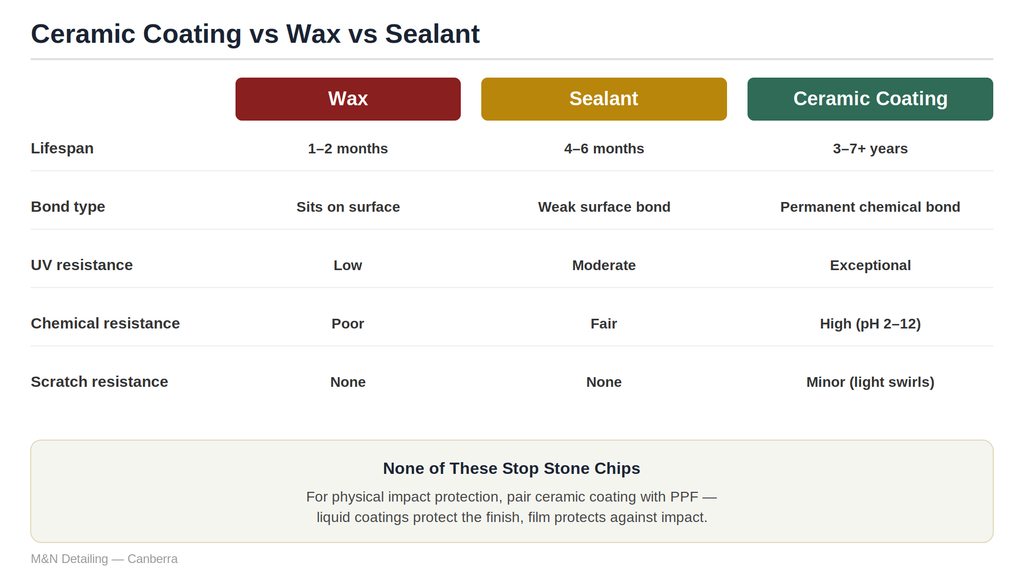
If you are weighing up your options, here is how the three main paint protection methods stack up against each other. Traditional Carnauba wax is made of natural palm wax, lasts one to two months, sits on top of the surface, offers low UV resistance, poor chemical resistance, and no scratch resistance. Synthetic paint sealants use synthetic polymers, last four to six months, form a weak surface bond, offer moderate UV resistance, fair chemical resistance, and no scratch resistance.
Professional ceramic coatings use silicon dioxide or silicon carbide, last three to seven plus years, form a permanent chemical bond, offer exceptional UV resistance, high chemical resistance to pH 2 through pH 12, extreme long-lasting water beading, and very minor resistance to light wash swirls.
Frequently Asked Questions
Does ceramic coating stop scratches and stone chips?
No. Ceramic coatings reduce fine wash marring and tiny micro-swirls, but they do not add enough physical thickness to absorb stone impacts or deep key scratches. For chip protection, pair your coating with PPF.
Can I still get my car dirty, or do I need to baby it?
Drive it normally! The whole point of a coating is to make your life easier. Dirt still collects on the car, but because the surface is so slick, it rinses off effortlessly without heavy scrubbing.
How much maintenance does a ceramic coating actually need?
You do not need to polish or wax the car ever again. Just stick to a simple two-bucket hand wash routine using pH-neutral soap every few weeks, and avoid automatic wash bays with dirty nylon brushes.
Can ceramic coating be applied over PPF?
Yes! In fact, it is one of the best combinations available. The PPF stops rock chips and self-heals deeper scratches, while the ceramic topcoat gives the film extreme water beading and makes it much easier to keep clean.
Ready to see what proper paint preparation and permanent ceramic protection can do for your car? Bring your vehicle by for an in-person paint inspection. Get in touch today for a free assessment via our Ceramic Coating Service Page.